




What is a solid hard alloy end mill for aluminum?
Aluminum alloy is an important material widely used in manufacturing and other fields. Due to its advantages such as lightweight, high strength, corrosion resistance, and recyclability, it has become one of the indispensable materials in modern manufacturing and engineering fields.
Aluminum alloys are increasingly used in modern engineering and manufacturing because they not only reduce weight and improve energy efficiency, but also provide good strength and corrosion resistance. However, despite the many excellent properties of aluminum alloys, there are still some challenges in the machining process, which is where the importance of milling cutters comes into play.
Challenges and Solutions
The softness and viscosity of materials: The softness and viscosity of aluminum alloys make them prone to compression and cutting heat during processing. This may lead to cutting edge wear, shortened tool life, and surface quality issues. Milling cutters can effectively address these issues through their powerful cutting edges and cooling systems.
Surface smoothness requirements: Many aluminum alloy parts have very high surface smoothness requirements. The geometric shape and edge condition of milling cutters are crucial for obtaining high-quality surfaces, as they can reduce cutting marks and cutting vibrations, thereby providing a smoother machining surface.
Material removal rate: Due to the relatively soft nature of aluminum alloys, high material removal rates are usually required to improve processing efficiency. The cutting parameters and tool design of milling cutters can achieve high-speed machining while maintaining quality.
The main function of milling cutters
High quality cutting edge design: The cutting edge design of the milling cutter has been carefully optimized to provide better performance in aluminum alloy machining. These blade geometries and blade angles help reduce cutting forces, minimize tool wear, and provide high surface quality.
Cooling and lubrication system:
Milling cutters are typically equipped with efficient cooling and lubrication systems to reduce temperature during cutting, prevent thermal damage, and effectively flush chips. This helps maintain cutting performance, extend tool life, and provide consistent surface quality.
High material removal rate:
Milling cutters can efficiently process aluminum with high material removal rates. Its design and performance can achieve faster cutting speeds and larger feed rates, thereby accelerating the machining process.
Aluminum alloys play an important role in modern manufacturing due to their lightweight, high strength, and corrosion resistance. As a key tool for aluminum processing, milling cutters play an indispensable role in improving processing efficiency and quality. Its optimized blade design, cooling system, and high material removal rate make milling cutters an essential tool for obtaining high-quality aluminum alloy parts. Therefore, the correct selection and use of milling cutters are key factors in ensuring production efficiency in aluminum alloy processing.
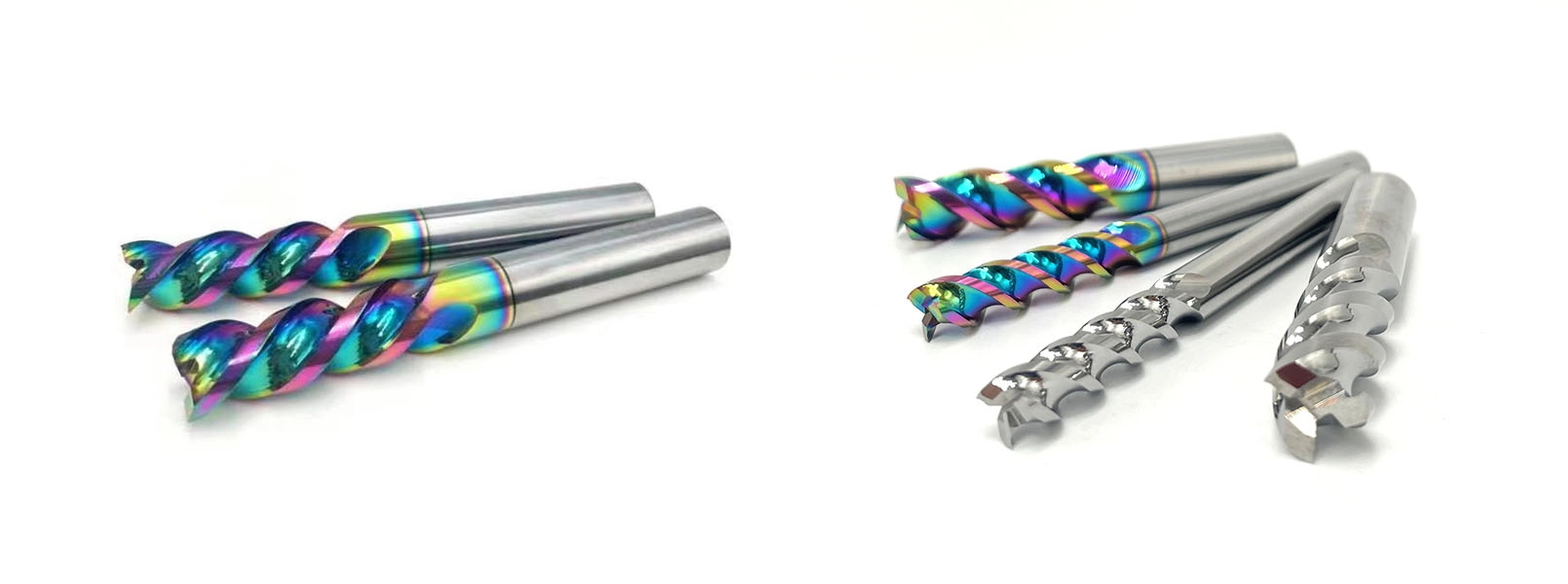
It is crucial to choose the appropriate type of milling cutter correctly during aluminum processing, as different milling cutter types are suitable for different machining tasks. Here are some types of solid carbide end mills for aluminum:
1. Flat end milling cutter:
Features: Flat bottom milling cutter with a flat bottom, usually used for face milling and side milling.
Application: Suitable for machining tasks such as the production of planes, grooves, holes, and contours. Commonly used for rough and precision machining of aluminum plates.
2. Ball end mill:
Features: The cutting edge of the ball end mill is spherical, suitable for surface and contour machining.
Purpose: Suitable for manufacturing curved, arc-shaped, and curved components such as automotive parts, aircraft casings, and molds.
3. Rounded end mill:
Features: Angle milling cutters have circular cutting edges that can reduce cutting stress and vibration.
Application: Suitable for manufacturing rounded and angled corners, providing better surface smoothness and reducing stress concentration on workpieces.
4. Face milling cutter:
Features: The surface milling tool has multiple cutting edges and is used for high-speed flat milling.
Purpose: Suitable for large-area surface milling, such as aluminum alloy plate processing.
5. Deep groove end mill:
Features: Deep groove milling cutters have long cutting edges, suitable for machining deep grooves or holes.
Application: Suitable for processing deep holes, grooves, and through holes, such as in the manufacturing of molds and mold parts.
6. High helix end mill:
Features: High milling cutters have steeper spiral cutting edges, which help effectively remove aluminum shavings.
Application: Suitable for high-speed milling, reducing aluminum chip accumulation and improving processing efficiency.
Choosing the appropriate type of milling cutter is crucial for aluminum processing, as it directly affects processing efficiency and quality. Different types of milling cutters are suitable for different machining tasks, and the correct selection can improve production efficiency, reduce costs, and ensure the quality and accuracy of workpieces. In aluminum alloy processing, engineers and operators should choose the appropriate type of milling cutter based on specific workpiece requirements and processing strategies.
There are various problems you may encounter during aluminum processing, but they can be solved or alleviated by selecting cutting tools correctly, optimizing cutting parameters, using appropriate coolants and lubricants, and following practice. The challenges faced by aluminum processing continue to drive engineers and operators to find better processing methods and technologies to improve production efficiency and ensure high-quality workpieces.
 Phone:
