


Custom Carbide End Mills
HomeCustom Carbide End Mills
Custom Carbide End Mills
End Mill Manufacturer
 Chip evacuation capacity and tool rigidity depend on the number of flutes.
End mills generally come in 2-, 3-, 4-, 5-, 6-, and 7-flute configurations.
The number of flutes is a key factor determining an end mill's performance. Fewer flutes result in larger chip pockets, facilitating chip evacuation; however, the tool's cross-sectional area is smaller, leading to reduced strength and a greater tendency to vibrate. Conversely, a higher number of flutes increases strength but results in smaller chip pockets, reducing chip-holding capacity and increasing the risk of clogging.
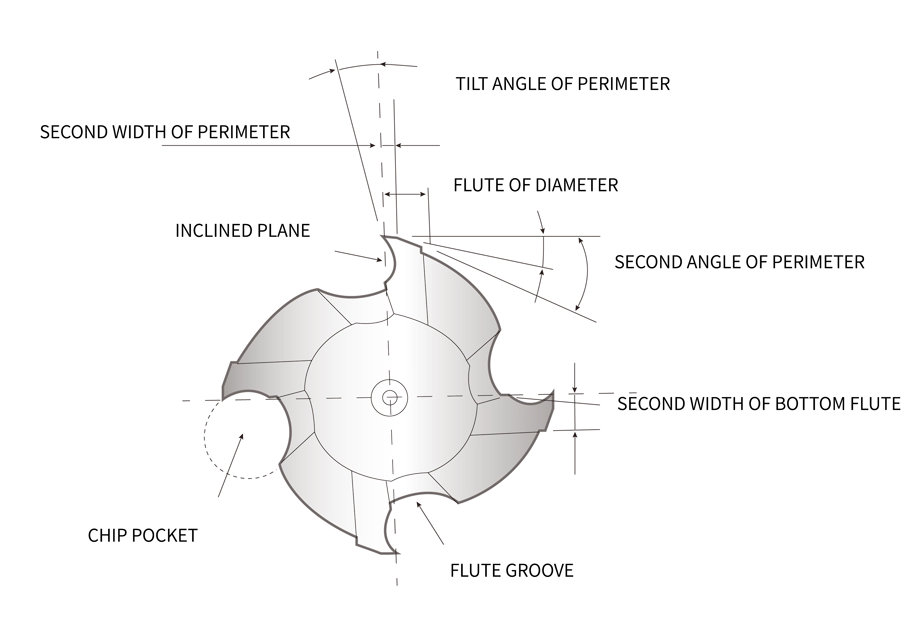
● A higher number of cutting edges increases the effective cutting area, enabling faster feed rates and greater cutting efficiency.
● Multi-flute milling heads can also reduce vibration and cutting forces, improve surface finish, lower cutting temperatures, and extend tool life.
● However, an excessive number of cutting edges may reduce the chip load per tooth, thereby lowering the cutting efficiency of each individual edge.
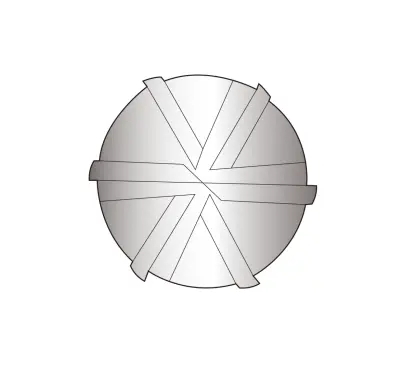
1-flute end mill
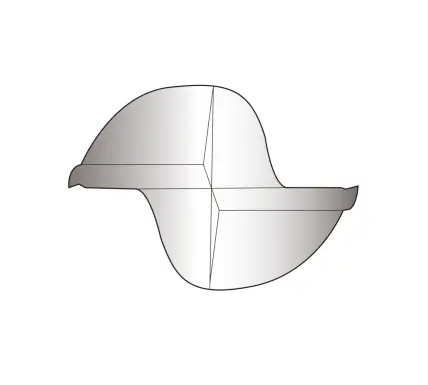
2-flute end mill
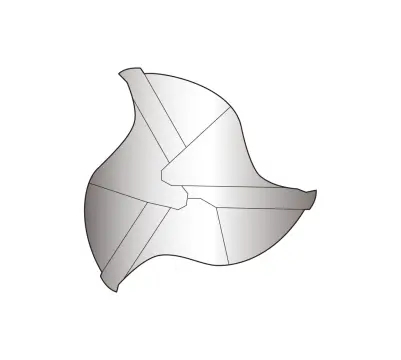
3-flute end mill
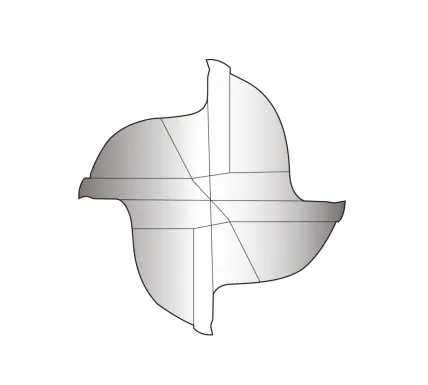
4-flute end mill
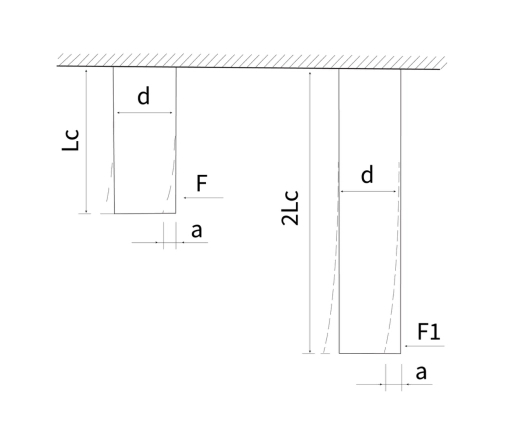
Tool rigidity depends on the flute length.
The shorter the tool length, the higher the rigidity and cutting performance.
● If the flute length is doubled, the rigidity of the end mill drops to one-eighth of its original level.
● End mills are tools designed for horizontal movement.
● There is an inverse relationship between tool rigidity and flute length.
● Using an excessively long end mill is not advantageous.
● We offer a product range with various flute lengths, allowing you to select the appropriate length for your specific machining application.
● We offer products with various base shapes and a wide range of applications.
● Base shape options include square, spherical, and rounded ends.
● Standard sizes are available in stock.
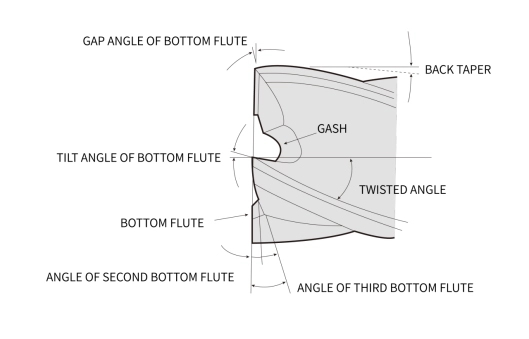
Square End Milling Cutter
The 4-edge flat bottom tungsten steel milling cutter has strong performance and high cost-effectiveness advantages, suitable for machining and cutting different materials.
Perform precision milling or rough milling, groove milling, removal of large amounts of blanks, precision milling of small horizontal surfaces or contours.
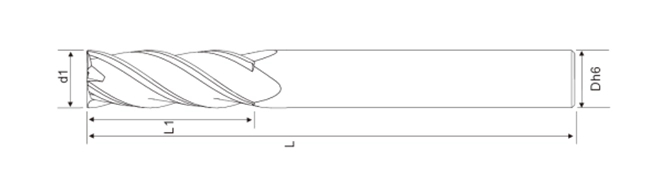
Ball End Mill
The chip groove is similar to a ball head and is assembled on a milling machine for milling various curved surfaces and circular arc grooves. This tool can mill mold steel, cast iron, carbon steel, alloy steel, tool steel, ordinary iron, etc. It belongs to end mills. Ball end milling cutters can work normally in high temperature environments.
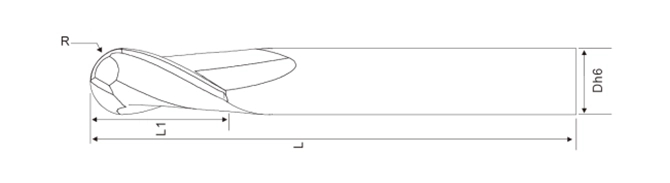
Edge Radius End Mill
The rounded end mill has a slight rounded corner, which helps to evenly distribute cutting force, prevent damage to the end mill, and extend its service life. They can create flat bottomed grooves with slightly rounded inner corners. The general fillet radius is R0.5 and R1.
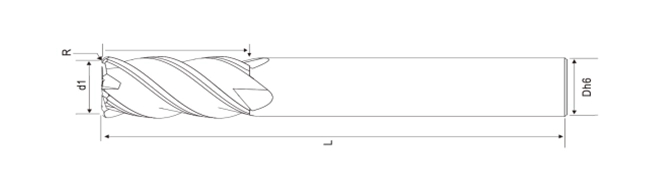
● The diameter of the end mill head plays a crucial role in determining the machining capability, accuracy, and versatility of these cutting tools.
The head diameter refers to the width of the cutting portion of an end mill, which directly affects the size and shape of the features it can create.
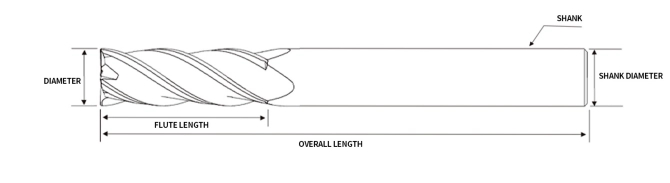
● Larger tool head diameters (6, 7, 10, 12 mm end mills) are suitable for heavy-duty machining tasks, such as rough machining or material removal at higher feed rates. They can handle deeper cuts and typically provide better stability due to increased cross-sectional area. This makes them very suitable for processing larger components and achieving faster material removal rates.
● On the other hand, smaller head diameters (0.5, 1.5, 1mm end mills) are very suitable for complex and precise operations. They excel at completing tasks that require fine details, strict tolerances, and smooth surface finish. They are small in size and can be used for complex contours, intricate cavities, and delicate contouring in small spaces.
● In many cases, a certain range of end mill head diameters is required to meet various machining requirements. Manufacturers offer a variety of sizes and geometries of end mills to choose from, enabling mechanics to select the most suitable tool for each specific task. Whether in aerospace, automotive, mold manufacturing, or general machining applications, the diameter of end mill heads is a key consideration for optimizing performance and achieving the desired machining results.
We provide different types of milling cutters for different processing materials, which can make the processing efficiency faster and more accurate.
Steel Milling Cutter
High quality cutting milling cutters adopt special blade and groove design, bringing more efficient cutting; Unequal helix suppresses tool vibration; High quality rod, nano coating, high hardness, long service life.
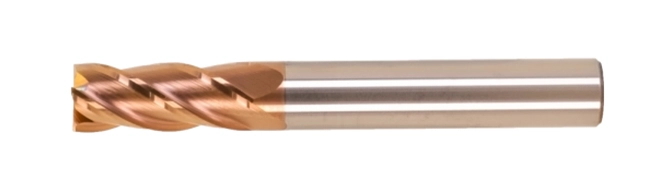
Special Milling Cutter for Difficult to Cut Materials
Suitable for heavy-duty cutting applications such as slotting and efficient milling. Advanced coating with high wear resistance; Processing of stainless steel, titanium alloy, and heat-resistant alloy.
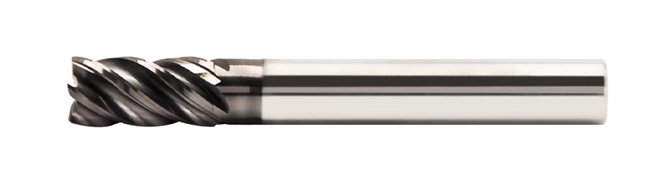
Aluminum Milling Cutter
Specially designed for aluminum parts with high surface finish; 3 blade groove design, excellent chip removal ability; Excellent cutting performance and higher cutting accuracy.
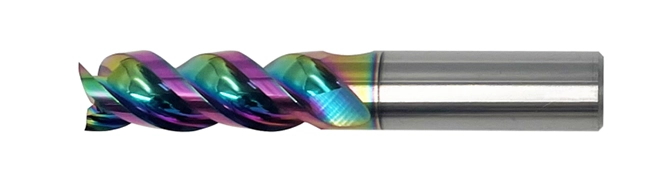
● A milling cutter is a tool used in CNC milling, mainly for milling flat surfaces, grooves, side surfaces, and other processes on a milling machine. End mills can cut horizontally into materials and create grooves or contours.
● Customers choose tools with high durability and good performance based on the material, quality requirements, cutting performance, and machining allowance of the processed parts.
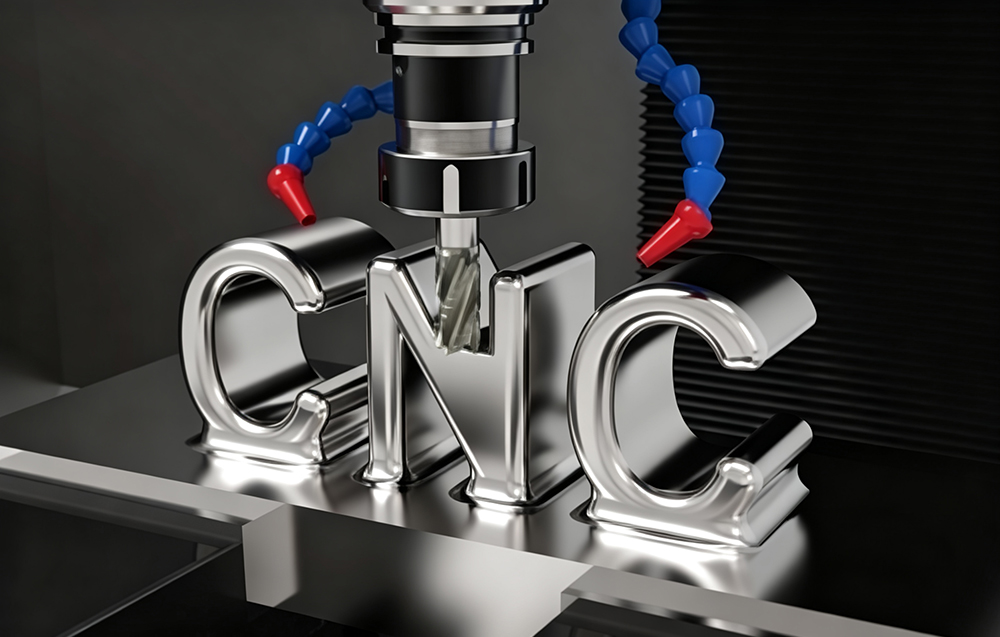
Hard alloy milling cutters are widely used in aerospace, medical equipment, mold manufacturing, automotive, and general engineering.
 Metal Processing
Milling cutters play an important role in the machining of metal materials. Can be used for cutting, slotting, boring, drilling and other operations, manufacturing various metal parts such as gears, bearing seats, connectors, etc. Milling can be performed at different angles and depths to obtain the desired shape and size.
 Mold Manufacturing
Milling cutters are used to manufacture molds, such as injection molds, die-casting molds, and stamping molds. It can accurately cut the contour and details of the mold, ensuring the accuracy and consistency of the final product.
 Aerospace Industry
Milling cutters also play a crucial role in the manufacturing of aircraft parts and aerospace equipment. It can process complex surfaces and holes, ensuring the accuracy and quality of parts while reducing weight and improving performance.
 Automobile Manufacturing
Milling cutters are used to manufacture automotive engine parts, chassis components, and body structures. It can accurately cut engine cylinder blocks, crankshafts, brakes, and suspension components to improve vehicle reliability and performance.
 Energy Equipment
Milling cutters also have important applications in energy equipment manufacturing, such as the machining of turbine mechanical components in power plants and nuclear power equipment.
| ISO Material | Normal Machining | Rough Machining | High-Efficiency Machining | High-Speed Machining | Micro Machining | |
|---|---|---|---|---|---|---|
P | Carbon Steel, Alloy Steel (<35HRC) | P20F | P20F | P20F | P20F | |
| Alloy Steel (35–48HRC) | ||||||
| PH, Cast Iron, Malleable Cast Iron (<35HRC) | ||||||
M | Stainless Steel | M20F | M20F | |||
K | Gray Cast Iron, Ductile Cast Iron (<32HRC) | P20F | P20F | P20F | ||
| High-Alloy Cast Iron (35–45HRC) | ||||||
N | Wrought / Cast Aluminum Alloy (Si ≤ 12%) | N25UF | N25UF | |||
| Cast Aluminum Alloy (Si > 12%) | ||||||
| Copper Alloy (<200HB) | ||||||
| Stone Composite Materials | NGK05A | |||||
S | Heat-Resistant Alloy (<450HB) | M20F | M20F | |||
| Titanium Alloy (<400HB) | ||||||
H | Hardened Steel (45–55HRC) | H25UF | H25UF | H25UF | ||
| Hardened Steel (55–60HRC) |
| Mark | Description | |
|---|---|---|
| Coating |  | AlCrSiN Coating |
 | TiSiN Coating | |
 | Diamond Coating | |
| Helix Angle |  | 35° Helix Angle |
 | 40° Helix Angle | |
 | 45° Helix Angle | |
| Flute Count |  | 2-Flute End Mill |
 | 3-Flute End Mill | |
 | 4-Flute End Mill | |
 | 5-Flute End Mill | |
| Milling Conditions |  | For Side Milling |
 | For Slotting | |
 | For Copy Milling |
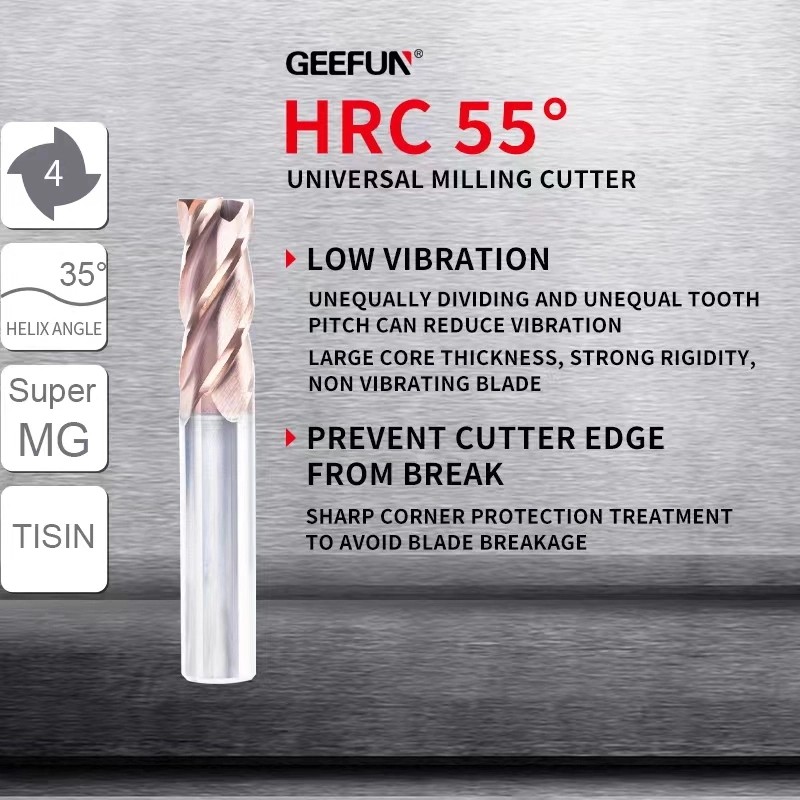
General-purpose TiSiN coating
A general-purpose coating offering excellent performance when machining materials with hardness up to HRC55, including select carbon steels, alloy steels, and stainless steels. It is suitable for use on both milling cutters and drills.
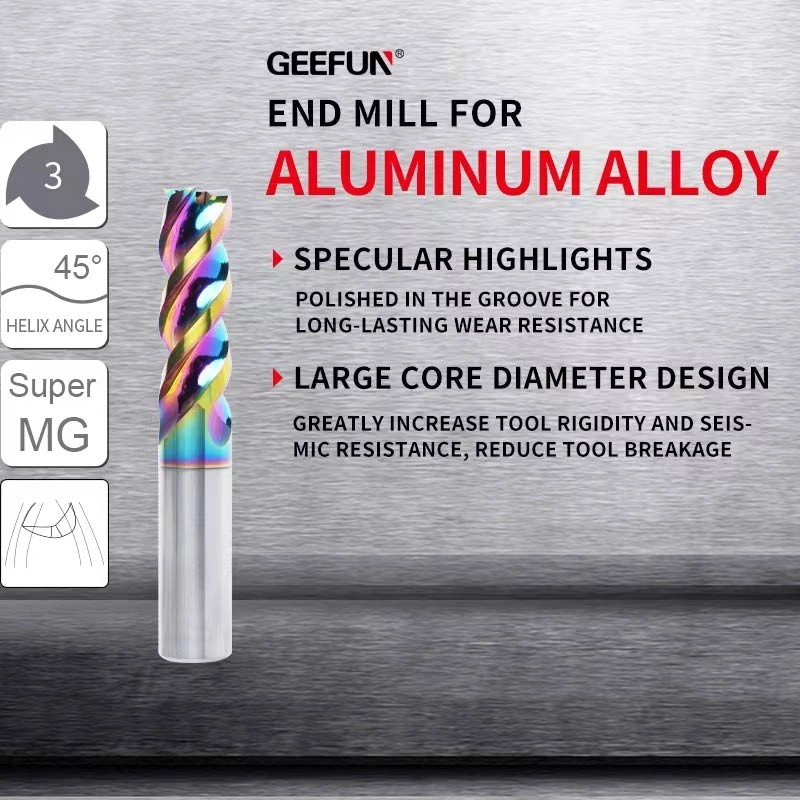
DLC Coating (for Aluminum)
Suitable for machining soft materials such as copper, aluminum, magnesium alloys, zinc alloys, and acrylic. The DLC coating features a low coefficient of friction, preventing aluminum adhesion. It yields a high-quality surface finish, ensures effective chip evacuation, and delivers high machining efficiency.
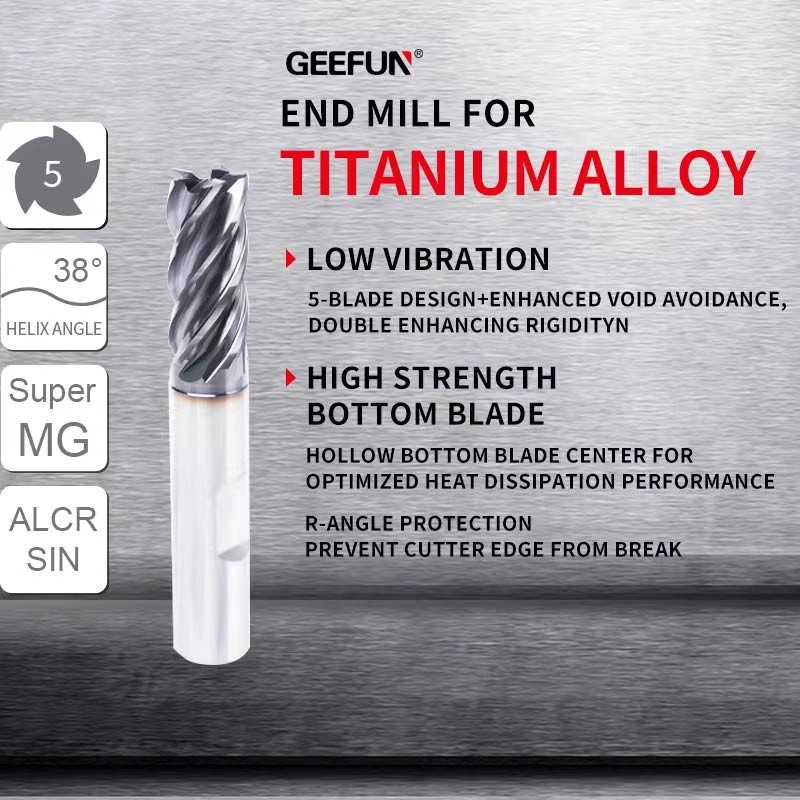
Balzers PT Coating
A high-end, nano-structured milling coating designed for difficult-to-machine materials; the preferred choice for stainless steel, titanium alloys, and nickel alloys. This multilayer nanocomposite coating offers high hardness, high strength, and excellent wear resistance.
Custom Carbide End Mills
End Mill Manufacturer
Chip evacuation capacity and tool rigidity depend on the number of flutes.
End mills generally come in 2-, 3-, 4-, 5-, 6-, and 7-flute configurations.
The number of flutes is a key factor determining an end mill's performance. Fewer flutes result in larger chip pockets, facilitating chip evacuation; however, the tool's cross-sectional area is smaller, leading to reduced strength and a greater tendency to vibrate. Conversely, a higher number of flutes increases strength but results in smaller chip pockets, reducing chip-holding capacity and increasing the risk of clogging.
● A higher number of cutting edges increases the effective cutting area, enabling faster feed rates and greater cutting efficiency.
● Multi-flute milling heads can also reduce vibration and cutting forces, improve surface finish, lower cutting temperatures, and extend tool life.
● However, an excessive number of cutting edges may reduce the chip load per tooth, thereby lowering the cutting efficiency of each individual edge.
1-flute end mill
2-flute end mill
3-flute end mill
4-flute end mill
Tool rigidity depends on the flute length.
The shorter the tool length, the higher the rigidity and cutting performance.
● If the flute length is doubled, the rigidity of the end mill drops to one-eighth of its original level.
● End mills are tools designed for horizontal movement.
● There is an inverse relationship between tool rigidity and flute length.
● Using an excessively long end mill is not advantageous.
● We offer a product range with various flute lengths, allowing you to select the appropriate length for your specific machining application.
● We offer products with various base shapes and a wide range of applications.
● Base shape options include square, spherical, and rounded ends.
● Standard sizes are available in stock.
Square End Milling Cutter
The 4-edge flat bottom tungsten steel milling cutter has strong performance and high cost-effectiveness advantages, suitable for machining and cutting different materials.
Perform precision milling or rough milling, groove milling, removal of large amounts of blanks, precision milling of small horizontal surfaces or contours.
Ball End Mill
The chip groove is similar to a ball head and is assembled on a milling machine for milling various curved surfaces and circular arc grooves. This tool can mill mold steel, cast iron, carbon steel, alloy steel, tool steel, ordinary iron, etc. It belongs to end mills. Ball end milling cutters can work normally in high temperature environments.
Edge Radius End Mill
The rounded end mill has a slight rounded corner, which helps to evenly distribute cutting force, prevent damage to the end mill, and extend its service life. They can create flat bottomed grooves with slightly rounded inner corners. The general fillet radius is R0.5 and R1.
● The diameter of the end mill head plays a crucial role in determining the machining capability, accuracy, and versatility of these cutting tools.
The head diameter refers to the width of the cutting portion of an end mill, which directly affects the size and shape of the features it can create.
● Larger tool head diameters (6, 7, 10, 12 mm end mills) are suitable for heavy-duty machining tasks, such as rough machining or material removal at higher feed rates. They can handle deeper cuts and typically provide better stability due to increased cross-sectional area. This makes them very suitable for processing larger components and achieving faster material removal rates.
● On the other hand, smaller head diameters (0.5, 1.5, 1mm end mills) are very suitable for complex and precise operations. They excel at completing tasks that require fine details, strict tolerances, and smooth surface finish. They are small in size and can be used for complex contours, intricate cavities, and delicate contouring in small spaces.
● In many cases, a certain range of end mill head diameters is required to meet various machining requirements. Manufacturers offer a variety of sizes and geometries of end mills to choose from, enabling mechanics to select the most suitable tool for each specific task. Whether in aerospace, automotive, mold manufacturing, or general machining applications, the diameter of end mill heads is a key consideration for optimizing performance and achieving the desired machining results.
We provide different types of milling cutters for different processing materials, which can make the processing efficiency faster and more accurate.
Steel Milling Cutter
High quality cutting milling cutters adopt special blade and groove design, bringing more efficient cutting; Unequal helix suppresses tool vibration; High quality rod, nano coating, high hardness, long service life.
Special Milling Cutter for Difficult to Cut Materials
Suitable for heavy-duty cutting applications such as slotting and efficient milling. Advanced coating with high wear resistance; Processing of stainless steel, titanium alloy, and heat-resistant alloy.
Aluminum Milling Cutter
Specially designed for aluminum parts with high surface finish; 3 blade groove design, excellent chip removal ability; Excellent cutting performance and higher cutting accuracy.
● A milling cutter is a tool used in CNC milling, mainly for milling flat surfaces, grooves, side surfaces, and other processes on a milling machine. End mills can cut horizontally into materials and create grooves or contours.
● Customers choose tools with high durability and good performance based on the material, quality requirements, cutting performance, and machining allowance of the processed parts.
Hard alloy milling cutters are widely used in aerospace, medical equipment, mold manufacturing, automotive, and general engineering.
Metal Processing
Milling cutters play an important role in the machining of metal materials. Can be used for cutting, slotting, boring, drilling and other operations, manufacturing various metal parts such as gears, bearing seats, connectors, etc. Milling can be performed at different angles and depths to obtain the desired shape and size.
Mold Manufacturing
Milling cutters are used to manufacture molds, such as injection molds, die-casting molds, and stamping molds. It can accurately cut the contour and details of the mold, ensuring the accuracy and consistency of the final product.
Aerospace Industry
Milling cutters also play a crucial role in the manufacturing of aircraft parts and aerospace equipment. It can process complex surfaces and holes, ensuring the accuracy and quality of parts while reducing weight and improving performance.
Automobile Manufacturing
Milling cutters are used to manufacture automotive engine parts, chassis components, and body structures. It can accurately cut engine cylinder blocks, crankshafts, brakes, and suspension components to improve vehicle reliability and performance.
Energy Equipment
Milling cutters also have important applications in energy equipment manufacturing, such as the machining of turbine mechanical components in power plants and nuclear power equipment.
| ISO Material | Normal Machining | Rough Machining | High-Efficiency Machining | High-Speed Machining | Micro Machining | |
|---|---|---|---|---|---|---|
P | Carbon Steel, Alloy Steel (<35HRC) | P20F | P20F | P20F | P20F | |
| Alloy Steel (35–48HRC) | ||||||
| PH, Cast Iron, Malleable Cast Iron (<35HRC) | ||||||
M | Stainless Steel | M20F | M20F | |||
K | Gray Cast Iron, Ductile Cast Iron (<32HRC) | P20F | P20F | P20F | ||
| High-Alloy Cast Iron (35–45HRC) | ||||||
N | Wrought / Cast Aluminum Alloy (Si ≤ 12%) | N25UF | N25UF | |||
| Cast Aluminum Alloy (Si > 12%) | ||||||
| Copper Alloy (<200HB) | ||||||
| Stone Composite Materials | NGK05A | |||||
S | Heat-Resistant Alloy (<450HB) | M20F | M20F | |||
| Titanium Alloy (<400HB) | ||||||
H | Hardened Steel (45–55HRC) | H25UF | H25UF | H25UF | ||
| Hardened Steel (55–60HRC) |
| Mark | Description | |
|---|---|---|
| Coating | | AlCrSiN Coating |
| TiSiN Coating | |
| Diamond Coating | |
| Helix Angle | | 35° Helix Angle |
| 40° Helix Angle | |
| 45° Helix Angle | |
| Flute Count | | 2-Flute End Mill |
| 3-Flute End Mill | |
| 4-Flute End Mill | |
| 5-Flute End Mill | |
| Milling Conditions | | For Side Milling |
| For Slotting | |
| For Copy Milling |
General-purpose TiSiN coating
A general-purpose coating offering excellent performance when machining materials with hardness up to HRC55, including select carbon steels, alloy steels, and stainless steels. It is suitable for use on both milling cutters and drills.
DLC Coating (for Aluminum)
Suitable for machining soft materials such as copper, aluminum, magnesium alloys, zinc alloys, and acrylic. The DLC coating features a low coefficient of friction, preventing aluminum adhesion. It yields a high-quality surface finish, ensures effective chip evacuation, and delivers high machining efficiency.
Balzers PT Coating
A high-end, nano-structured milling coating designed for difficult-to-machine materials; the preferred choice for stainless steel, titanium alloys, and nickel alloys. This multilayer nanocomposite coating offers high hardness, high strength, and excellent wear resistance.
please contact us immediately!
 Phone:
