




What is a hard alloy center drill bit?
Hard alloy center drill is a commonly used cutting tool in the field of metal processing. It is widely used in machining processes due to its high hardness, wear resistance, and good cutting performance.
Hard alloy material:
The main component material of the hard alloy center drill bit is hard alloy, also known as tungsten cobalt alloy. This material has excellent hardness and wear resistance, which enables the center drill to maintain stable performance under high-speed cutting and heavy-duty working conditions.
Structural features:
A center drill usually has a sharp center edge and cutting edges on both sides. The central edge is used for positioning and pre positioning holes, while the cutting edge is used for cutting materials. This structural design helps to improve machining accuracy and efficiency.
Application fields:
Hard alloy center drill bits are widely used in metal processing, including hole machining and positioning of materials such as steel, cast iron, and aluminum alloys. They are commonly used in manufacturing industries such as machining, automotive manufacturing, aerospace, etc.
High speed cutting:
Due to the high hardness and wear resistance of hard alloy, the center drill of hard alloy can maintain the stability of the cutting edge under high-speed cutting and improve machining efficiency.
Positioning and pre drilling: The center drill bit is commonly used for positioning and pre drilling during the machining process. Its sharp central edge helps ensure precise hole positioning and provides a starting point for subsequent machining steps.
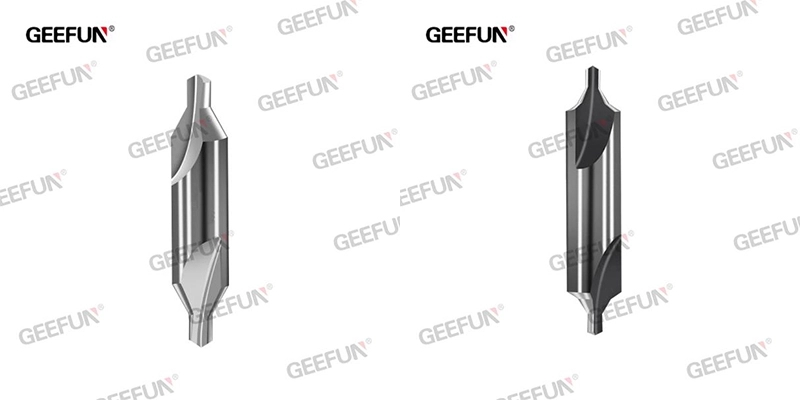
1、 Working principle of hard alloy center drill bit
The following is a basic introduction to the working principle of hard alloy center drills:
① Positioning function: The design of the hard alloy center drill bit includes a sharp center blade, whose main function is to position and accurately locate the tool at the beginning of machining. The central edge creates a small and precise hole on the material surface, providing a starting point for subsequent processing steps. This is crucial for ensuring the positional accuracy of the machined holes.
② Cutting action: The cutting action of the center drill is completed by the cutting edges on both sides. The design and angle of these edges allow the center drill to cut through the metal material to form the desired hole. The high hardness and wear resistance of hard alloys ensure that the cutting tool can maintain edge stability for a long time during the cutting process, extending its service life.
③ Cutting angle: Cutting angle is one of the key factors in the working principle of hard alloy center drill bits. The choice of cutting angle depends on the hardness and characteristics of the material being processed. A larger cutting angle can improve cutting efficiency, but may shorten tool life. Therefore, in practical applications, it is necessary to choose the appropriate cutting angle based on specific machining requirements and material properties.
④ Cooling and lubrication: Hard alloy center drill bits generate high temperatures during high-speed cutting. To prevent tool overheating and improve cutting efficiency, coolant or lubricating oil is usually required. These liquids can cool the tool and remove chips, thereby reducing friction and extending tool life.
2. Advantages of Hard Alloy Center Drill Bit
Hard alloy center drills have many advantages, making them an important cutting tool in metal processing. Here are some of the main advantages of hard alloy center drills:
① High hardness and good wear resistance: Hard alloy materials (usually tungsten cobalt alloys) have extremely high hardness, allowing the center drill bit to resist the hardness of the material during cutting while exhibiting excellent wear resistance. This enables hard alloy center drills to maintain cutting edge stability and extend their service life under high-speed cutting and heavy load conditions.
② Accurate positioning capability: The center drill bit has a unique design and a sharp center blade, which can accurately position and locate the tool. This is crucial for ensuring accurate hole positioning, especially in high-precision machining tasks.
③ Widely used: Hard alloy center drill bits are suitable for various metal materials, including steel, aluminum alloys, copper, etc. Due to its multifunctionality, it is widely used in the manufacturing industry, covering mechanical processing, automotive manufacturing, aerospace, and ETC.
④ Efficient high-speed cutting: Due to the hardness of hard alloys, the center drill bit can maintain stability for a long time during high-speed cutting, thereby improving machining efficiency. This is very important for large-scale production and time sensitive tasks.
⑤ High temperature resistance: During high-speed cutting, the surface of the tool will be affected by high temperatures. Hard alloy center drill bits have good high temperature resistance and can work in high temperature environments without failure.
⑥ Precision hole machining: Due to the sharp design of the center drill bit, it is suitable for precision hole machining. This is very important for applications that require high precision and surface quality, such as precision machine parts manufacturing.
3. Manufacturing process: Hard alloy center drill bit
Material preparation: The key to making a hard alloy center drill bit is to prepare the hard alloy material. Tungsten cobalt alloy is usually used, which is mainly composed of tungsten and cobalt. Mix two materials in powder form and then sinter them into hard alloy blanks through high-temperature sintering process.
Tool design: Tool design is a crucial step. Factors such as the overall structure, blade angle, and blade shape of the central drill bit need to be considered. The design goal is to ensure that the center drill bit can provide good cutting performance, precise positioning ability, and a long service life. During this stage, computer-aided design (CAD) and computer-aided manufacturing (CAM) technologies are often applied.
Material Forming: Accurately machining the shape of cutting tools through CNC machining equipment or mold forming equipment. The hard alloy blank is gradually formed into the predetermined shape of the center drill bit through precision cutting or grinding.
Heat treatment: Forming tools may require heat treatment to increase their hardness and wear resistance. The heat treatment process usually includes steps such as quenching and tempering to ensure that the cutting tool has the required physical and mechanical properties.
Coating: In order to improve the surface hardness of hard alloy center drill bits and reduce the friction coefficient, tool coatings such as titanium carbide, titanium nitride, etc. are usually coated on the surface of the tool. This helps to extend the tool life, improve the tool's service life, and enhance cutting performance.
Final processing: This may include further cutting or grinding to ensure that the tool geometry and surface quality meet the design requirements.
Quality inspection: After the manufacturing of the hard alloy center drill bit is completed, it needs to undergo strict quality inspection. This may include visual inspection, dimensional measurement, hardness testing, etc., to ensure that the quality of the tool meets the standards.
Each of the above steps requires precise process control and high-level manufacturing technology to ensure that the final produced hard alloy center drill has superior performance and stable quality.
Overall, hard alloy center drills are widely used in the manufacturing industry, providing efficient, accurate, and reliable cutting solutions for various fields.
 Phone:
