




Which type of end mill is more suitable for processing stainless steel?
A milling cutter is a multi blade cutting tool. The total length of the cutting edges involved in cutting is relatively long. There is no empty stroke during cutting, and a higher cutting speed can be used. When milling stainless steel with a regular end mill, according to the actual usage on the production site, the tool wears severely, and chips adhere to the tool, seriously affecting the service life of the tool. When using ordinary end mills to process stainless steel, the efficiency is low, the operating cost is high, and the processing quality cannot meet customer requirements. Therefore, a specialized end mill that can achieve stainless steel milling has emerged in the market, which is specifically designed for stainless steel end mills.
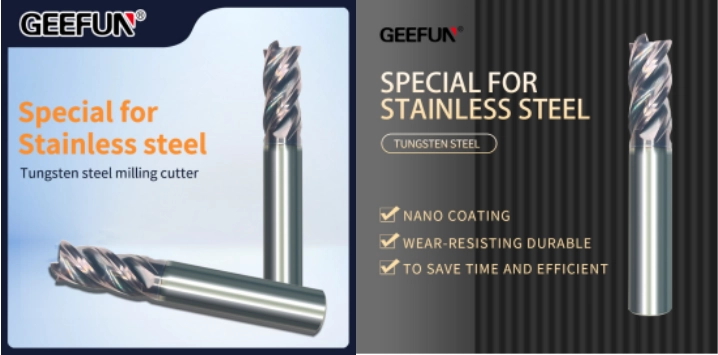
Stainless steel special milling cutter is a tool used for machining stainless steel materials, usually used for cutting, milling, slotting, and surface processing. You can learn the basic information of stainless steel special milling cutters through the following information.
Ingredients:
Stainless steel special milling cutters are made of hard alloy material, which has high hardness and wear resistance, making it suitable for high-speed cutting of hard materials such as stainless steel. According to the cutting characteristics of stainless steel, it can be seen that cutting tools should meet the following requirements during manufacturing and cutting: have sufficient hardness to reduce plastic deformation of the substrate; Tool materials are beneficial for achieving and maintaining sharp edges; The cutting edge of the tool is arc-shaped, and the radius can be made smaller. Therefore, solid hard alloy materials are more suitable for processing stainless steel, and submicron crystal materials with a grain size of 0.6 μ m are the better end mills for processing stainless steel.
Cobalt content 10, grain size 0.6, Rockwell hardness (HRA) 91.6, density 14.45, strength 3800.
Types of cutting tools:
Stainless steel milling cutters include flat bottom milling cutters, ball end milling cutters, and round nose milling cutters. Each type is suitable for different processing tasks. These milling cutters can process 99% of stainless steel materials.
Coating:
The cutting performance of stainless steel material is poor, and it has a strong affinity with the tool surface. Chips will adhere to the surface of the cutting edge, forming chip deposits and causing particles at the interface between the coating and the substrate to diffuse onto the chips. Causing chemical wear and tear. In order to solve the cutting difficulties of stainless steel materials and the wear resistance of cutting tools, and improve the wear resistance and service life of stainless steel special milling cutters, a layer of hard alloy coating is usually plated on their surface, such as coated nano chromium aluminum nitride silicon (AlCRSiN) or coated aluminum oxide (AlTiN), which is more suitable for the cutting requirements of stainless steel materials.
Number of grooves:
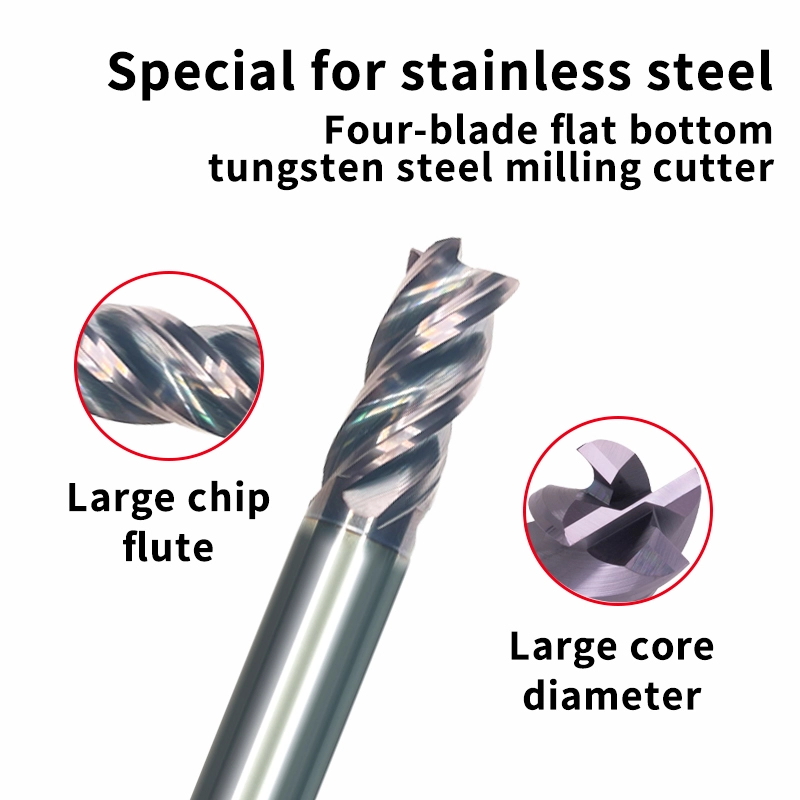
The number of grooves for stainless steel special milling cutters can vary depending on the application. Generally speaking, multi edge milling cutters can provide higher machining efficiency. Hard alloy end mills generally use higher rotational speeds during cutting. The cutting force of the tool during cutting will be distributed to each blade. The more blades there are, the less force is allocated to each cutting edge. But when there are too many cutting edges, the space for the chip groove will decrease, resulting in the inability to discharge iron chips in a timely manner during high-speed cutting. Based on the comprehensive consideration of the above two aspects, many suppliers usually adopt a four blade structure when producing stainless steel special hard alloy end mills.
Cutting speed and feed rate:
Cutting speed 10-140m/min; Feed rate 0.013-0.15mm/z. When using stainless steel special milling cutters, it is necessary to choose the appropriate cutting speed and feed rate according to the specific material and workpiece requirements to ensure cutting quality and tool life.
Cooling and lubrication:
Due to the high calorific value and poor machinability of stainless steel, sufficient cooling, lubrication, infiltration, and cleaning are usually required to reduce heat and tool wear. This can be achieved through coolant or lubricant. Emulsion is a common cooling method. Cutting oil has good lubrication and a certain cooling effect. This can be achieved through coolant or lubricant.
Safety precautions:
In order to achieve better processing results in stainless steel processing, the surface of milling cutters must have high glossiness. When using stainless steel special milling cutters, the cutting force is high and the moving parts must be tightened. Please follow the safety operating procedures and wear personal protective equipment to ensure the safe operation of tools.
The stainless steel special milling cutter adopts a four blade chip groove design with unequal tooth pitch, which enables the tool to have good chip removal performance during cutting, with less vibration during cutting and maintaining cutting stability. Therefore, the design of stainless steel specific end mills can meet the cutting requirements of most stainless steel materials.
 Phone:
