Author: Site Editor Publish Time: 2023-10-19 Origin: Site
Aluminum alloy is an important material widely used in manufacturing and other fields. Thanks to its light weight, high strength, corrosion resistance and recyclability, it has become indispensable in modern manufacturing and engineering fields. One of the materials.
The use of aluminum alloys is increasing in modern engineering and manufacturing as it not only reduces weight and improves energy efficiency, but also provides good strength and corrosion resistance. However, despite its many excellent properties, aluminum alloys still face some challenges during machining, and this is where the importance of milling cutters comes into play.
Material softness and stickiness: The softness and stickiness of aluminum alloys make it easy to generate extrusion and cutting heat during processing. This can lead to cutting edge wear, reduced tool life, and surface quality issues. Milling cutters can effectively cope with these problems through their strong cutting edges and cooling systems.
Surface finish requirements: Many aluminum alloy parts have very high surface finish requirements. Milling cutter geometry and edge condition are critical to achieving a high-quality surface, as they reduce cutting marks and cutting vibrations, providing a smoother machined surface.
Material Removal Rate: Due to the relative softness of aluminum alloys, high material removal rates are often required to increase processing efficiency. The milling cutter's cutting parameters and tool design enable high-speed machining while maintaining quality.
HIGH QUALITY CUTTING EDGE DESIGN: The milling cutter's edge design is carefully optimized to provide the best performance in aluminum alloy machining. These edge geometries and edge angles help reduce cutting forces, reduce tool wear and provide high surface quality.
Milling cutters are usually equipped with efficient cooling and lubrication systems to reduce temperatures during cutting, prevent thermal damage, and effectively flush cutting chips. This helps maintain cutting performance, extend tool life, and provide consistent surface quality.
Milling cutters enable efficient aluminum machining at high material removal rates. Its design and performance allow for faster cutting speeds and greater feed rates, thus accelerating the machining process.
Aluminum alloys play an important role in modern manufacturing due to their light weight, high strength and corrosion resistance. As a key tool in aluminum processing, milling cutters play an indispensable role in improving processing efficiency and quality. Its optimized edge design, cooling system and high material removal rate capabilities make the milling cutter an essential tool for achieving high-quality aluminum alloy parts. Therefore, in aluminum alloy processing, the correct selection and use of milling cutters is a key factor in ensuring production efficiency.

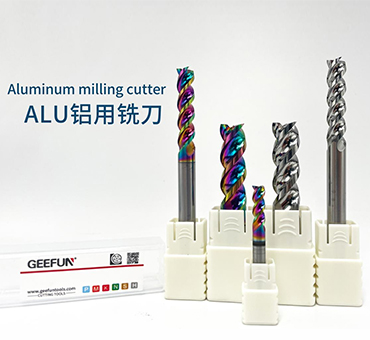
Correct selection of the appropriate type of milling cutter is crucial during aluminum machining, as different milling cutter types are suitable for different machining tasks. The following is an introduction to some types of solid carbide end mills for aluminum:
Features: Flat bottom milling cutters have a flat bottom and are typically used for face milling and side milling.
Application: Suitable for machining tasks such as the production of flat surfaces, grooves, holes and contours. Commonly used for roughing and finishing of aluminum sheets.
Features: The cutting edge of the ball nose end mill is spherical, suitable for curved surfaces and contour machining.
Application: Suitable for manufacturing curved, curved and curved shaped components such as automotive parts, aircraft casings and moulds.
Features: Angle milling cutters have rounded cutting edges that reduce cutting stress and cutting vibration.
Application: Suitable for manufacturing fillets and bevels, providing better surface finish and reducing stress concentration on the workpiece.
Features: Face milling cutters have multiple cutting edges and are used for high-speed surface milling.
Application: Suitable for large-area surface milling, such as processing of aluminum alloy plates.
Features: Deep groove milling cutters have long cutting edges for machining deep grooves or holes.
Application: Suitable for processing deep holes, grooves and through holes, such as in the manufacture of molds and mold parts.
Features: Tall cutters have steeper helical cutting edges that help remove aluminum chips efficiently.
Application: Suitable for high-speed milling to reduce the accumulation of aluminum chips and improve processing efficiency.
Choosing the appropriate type of milling cutter is crucial for aluminum processing as it will directly affect the processing efficiency and processing quality. Different types of milling cutters are suitable for different processing tasks, and the correct choice can improve production efficiency, reduce costs, and ensure the quality and accuracy of workpieces. In aluminum alloy machining, engineers and operators should select the appropriate milling cutter type based on specific workpiece requirements and machining strategies.

The problems you may face during aluminum machining are diverse, but they can be solved or mitigated through proper selection of cutting tools, optimizing cutting parameters, using appropriate coolants and lubricants, and following best practices. The challenges of aluminum machining are constantly driving engineers and operators to search for better machining methods and technologies to increase production efficiency and ensure high-quality workpieces.
From September 11th to 13th, 2025, the 2nd CMES (China Machinery Exhibition)—Ningbo International Machine Tool Exhibition—delivered a packed house at the Ningbo International Convention and Exhibition Center! With the ambition to "lead and take the lead," the 2025 China Machinery Exhibition showcase
Key Differences Between Spiral Reamers and Straight-Flute ReamersAs common tools in reaming operations, spiral reamers and straight-flute reamers exhibit core differences in structural design, machining performance, application scenarios, and other aspects. The specific distinctions can be analyzed
In the eyes of most, industrial manufacturing is a torrent of steel, an outpouring of force, a grand narrative. However, the true beauty of modern manufacturing often lies hidden in the microscopic world, invisible to the naked eye. There, a seemingly unassuming flat-bottom milling cutter, at tens o
The end mill (also commonly referred to as a "bullnose end mill") is a widely used tool type in milling operations. Its core feature is a small-radius arc transition at the end of the cutting edge (as opposed to the right angle of a flat-end mill or the full spherical shape of a ball-end mill). This
In workshops buzzing with machines, on the turrets of various CNC machining centers, flat-bottom milling cutters are undoubtedly one of the most common and mundane tools. Unassuming in appearance and simple in structure, they resemble an insignificant screw in the industrial world. Yet, it is this s
The core differences between general-purpose milling cutters and high-hardness milling cutters lie in multiple dimensions such as design objectives, performance parameters, and application scenarios, which can be analyzed in detail from the following aspects:First, there is a significant difference
Rough Leather Mill: The Efficient Powerhouse in Metal Processing In the field of modern metal processing, rough leather mills are increasingly becoming the tool of choice for engineers and machinists. With their unique design and remarkable efficiency improvements, these specially engineered cutters
Internal Coolant Drill BitsInternal coolant drill bits are highly efficient cutting tools widely used in drilling operations. Their core feature is the ability to deliver cutting fluid directly to the cutting zone (the contact area between the tool and the workpiece) through internal cooling channel
The spotting drill, as the name suggests, is a short-cutting-edge drill bit specifically designed for machining precise pilot holes and center holes on workpieces. It is an indispensable preparatory tool in machining, particularly in CNC machining centers and turn-mill centers. Its primary purpose i
Boring Tool: A Key Tool for Precision Hole MachiningA boring tool is a cutting tool used for boring operations in mechanical processing. It is mainly used for further processing of existing holes to improve their dimensional accuracy, shape precision, and surface quality. It plays an irreplaceable r
In the kingdom of metalworking, tapping—the process of cutting precise internal threads in a hole—is a critical step in the birth of countless parts. Among the arsenal of threading tools, the straight flute tap occupies an irreplaceable position due to its unique structure and reliable performance.
Metalloobrabotka is an internationally renowned trade fair for metalworking and machine tool industries, held annually since 1984 at the Expocentre exhibition center in Moscow, Russia. Expocentre boasts modern and well-equipped facilities, providing an ideal venue for this event. Organized by Russia
GEEFUN booth - Hall 2.5-25C63 2024 METALLOOBRABOTKATIME/MAY 20-24,2024 ADD/EXPOCENTRE FAIRGROUNDS,MOSCOW,RUSSIABOOTH NO /25C63Our team of experts is here to help you find the perfect tools for your business needs. The exhibition is in full swing, looking forward to meeting you at the booth!
Dear customers,Due to the Spring Festival holiday, our company will be on holiday from February 5 to February 20, 2024.It will officially resume work on February 21, 2024.If you have any urgent matters during this period, please send an email. We will get back to you as soon as possible.Thank you fo
In aerospace machining, where materials like titanium and other high-strength alloys are common, milling cutters play a crucial role in shaping and finishing components. Machining parameters should be carefully selected based on the material being cut. Sturdy tool setups and stable machining conditi
Carbide roughened milling cutter is a cutting tool, usually made of hard carbide material, used to remove excess material from a workpiece to obtain the desired shape and size.Designed for efficient roughing tasks, this type of tool typically has a cutting edge with multiple teeth, each with a speci
A thread milling cutter is a tool for cutting threads through milling. In the past, the traditional thread processing method was usually through taps, etc. With the continuous development and progress of CNC technology, more advanced thread milling cutter processing methods have emerged. It has exce
Carbide center drill is a cutting tool commonly used in the field of metal processing. It is widely used in the processing process for its high hardness, wear resistance and good cutting performance. Carbide material: The main component material of the carbide center drill bit is cemented carbide, a
In early December, our company participated in the 2023 Indonesia Machine Tool Exhibition held in Jakarta, Indonesia. As an enterprise committed to innovative technology and manufacturing development, we participated in this event to discuss future opportunities in the manufacturing industry with i
In modern manufacturing, efficient cutting tools are an important part of the production process. Tungsten steel long neck milling cutter, as a cutting tool, plays a key role in various fields. Its material and design features make it an indispensable tool in the process industry. Tungsten steel lon
Building 6-5, No 200 Da tong west road, Niutang Town,Wujin District, Changzhou,Jiangsu,China
苏公网安备32040002010481号